

Build or Outsource? The Real Math Behind Fulfillment in Indonesia
Outsourcing fulfillment in Indonesia pays off below your break-even volume. This guide gives the formula, four hidden warehouse costs, and a control framework.
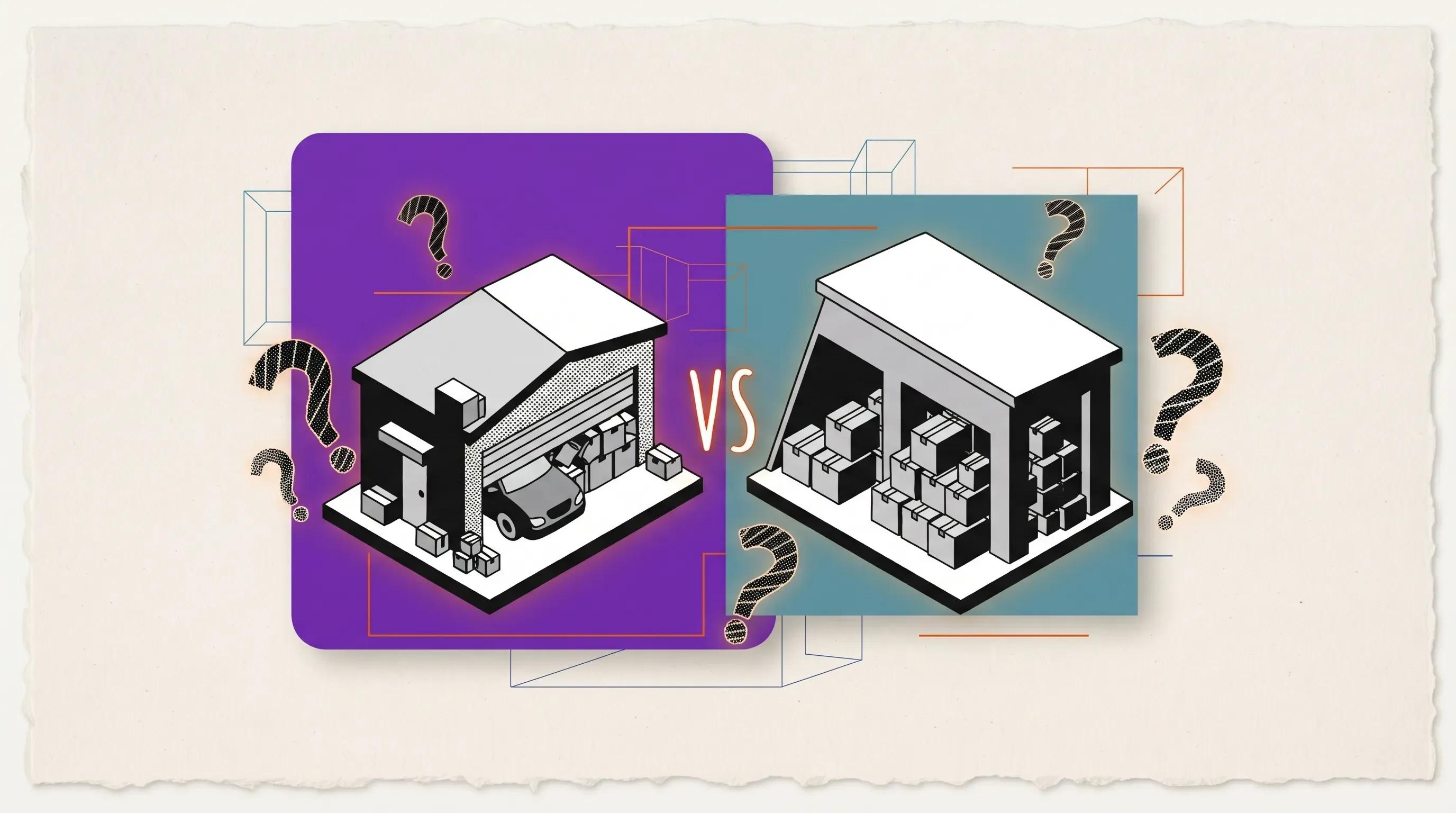
Outsourcing to a fulfillment service in Indonesia pays off whenever your monthly volume sits below your break-even point, and a short formula shows where that point is. Above it, in-house costs less per order only while the warehouse stays full. Below it, rent, idle labor, and peak capacity eat margin.
Why In-House Fulfillment Stops Working for Fast-Growing Brands
In-house fulfillment stops working when warehouse capacity, which you buy in fixed steps, falls out of sync with order volume, which grows in a curve.
A lease, a shift of pickers, and a WMS license are each sized for the volume you expect, not the volume you get. Grow past the plan and you run short of racks, people, and dock time within weeks. Grow slower and you keep paying for space you do not use.
Selling on several channels widens the gap. Orders from Shopee, Tokopedia, TikTok Shop, and your own site arrive in different formats and at different rates, and campaign days such as 11.11 and 12.12 compress weeks of demand into a few days. Opening a second origin to cut delivery times means repeating the whole fixed-cost stack in another city.
The Hidden Costs Behind a “Cheaper” Warehouse
A warehouse looks cheaper than a 3PL when you compare rent to a per-order fee, but four costs sit outside that comparison: fixed rent, idle labor, peak-season capacity, and stock variance.
Fixed Rent
Rent is due whether you ship 100 orders or 10,000, so cost per order rises every time volume dips. A slow month shows up as a higher rent line per parcel, even though nothing about the warehouse got worse.
Idle Labor
Wages are fixed while orders are not. A team sized for campaign weeks waits for work in the quiet weeks, and a team sized for quiet weeks falls behind on campaign days.
Turnover makes it worse. Every new picker means retraining and another round of rewriting the SOP.
Peak-Season Capacity
Peak capacity means temporary staff, overtime, extra racking, and sometimes a second storage site, all used for a few weeks and then idle. The spend arrives as one-off invoices that rarely get allocated back to the orders that caused them.
Stock Variance
Counting errors, mispicks, and damaged goods land in inventory write-offs, not in the fulfillment budget. Without a WMS and regular cycle counts, the gap between system stock and shelf stock often shows up only at the next full stock take.
These four lines sit in different parts of the P&L, rent in overhead, wages in payroll, write-offs in inventory, which is why an in-house operation rarely produces one honest cost-per-order figure. A 3PL quote does, and that is part of why the comparison feels uneven.
A Cost and Control Framework for Choosing Between In-House and Outsourced Fulfillment
Compare in-house and outsourced fulfillment on four dimensions, cost structure, control, speed of scaling, and risk, then weight each one by what your growth stage demands.
Dimension | In-house | Outsourced (3PL) | Question to answer |
Cost structure | Mostly fixed: lease, payroll, systems. | Mostly variable: charged per order or item, plus storage by volume. | How much of your fulfillment cost falls when orders fall? |
Control | Direct control of process, hours, and packing. | Shared: you set specs and SLAs, the vendor runs the floor. | Which steps are core to your brand experience? |
Speed of scaling | Slower: needs space, hiring, and systems. | Faster: adds volume on the vendor’s existing capacity and locations. | How soon must a second city or a campaign-day surge be handled? |
Risk | You carry capacity, labor, and stock-variance risk. | The vendor carries facility and labor risk. You carry dependency and contract terms, such as minimum commitments. | Which risk can your team manage better than a vendor can? |
There is also a middle route that the table does not capture. If you already lease a warehouse, you can keep it and bring in an outside operations team and WMS to run it. Biteship's Run by Biteship (RBB) works this way. Your stock stays in your building and your current staff stay on, while Biteship's trained team and WMS bring a standard SOP to the floor. You keep control of the site and hand off the part that is hardest to hire for and retrain.
A brand entering a new region weights speed and variable cost most. A brand with stable volume and a signature unboxing experience weights control most. Score each row from 1 to 5 for your business, multiply by the weight, and compare the totals before you open the spreadsheet with the numbers.
The Break-Even Point and What It Does to Margin
Your break-even point is the monthly order volume at which your in-house cost per order equals the all-in cost per order a 3PL charges.
Keep shipping out of both sides, since you pay it either way. Then define three inputs:
- F, your fixed in-house cost per month: rent, permanent staff, WMS and equipment, utilities, and insurance.
- v, your variable in-house cost per order: packing materials, hourly or temporary labor, and shrinkage per order.
- c, the 3PL’s all-in cost per order: storage, inbound, pick and pack, additional items, packaging, returns, and any minimum commitment, divided by your monthly orders. Biteship’s cost guide lists these components.
In-house cost per order is F ÷ orders + v. Setting that equal to c gives the break-even volume:
Break-even orders per month = F ÷ (c − v)
Placeholder numbers show the mechanics, not benchmarks. If F is Rp30 million, v is Rp3,000, and c is Rp8,000, break-even is 30,000,000 ÷ 5,000 = 6,000 orders per month. At 4,000 orders, in-house costs Rp10,500 per order against Rp8,000 outsourced, a gap of Rp10 million per month in favor of outsourcing. At 9,000 orders, in-house costs about Rp6,333 per order, and the gap flips to Rp15 million per month in favor of in-house.
The margin effect is the cost gap per order multiplied by monthly orders. Divide it by monthly net revenue to see it in points of margin.
The result is a snapshot, so test the volume you expect, not just the volume you have. Each capacity step, such as a bigger lease or a second site, raises F and pushes break-even up. A 3PL’s tiers and minimum commitments change c, so ask for quotes at your low, normal, and peak volumes before you decide.
Run the Numbers Before You Sign a Lease or a Contract
Outsourcing wins below your break-even volume and while demand is hard to predict, and in-house wins above it only if the warehouse stays full and you accept the fixed-cost risk. Calculate F, v, and c from real quotes before you sign a lease or a contract.
Biteship Fulfillment handles storage, packing, and shipping for online brands from warehouses in Jakarta, Bandung, Surabaya, and Makassar, with a WMS that tracks stock in real time. If you already have a warehouse and want to keep it, Run by Biteship puts the same WMS and a trained team on your floor. Talk to Biteship sales with your SKU list and monthly orders to get a quote you can drop into the formula above. You can also read more on the Biteship Fulfillment page or the Run by Biteship page.
FAQ
At What Order Volume Does Outsourcing Pay Off?
Outsourcing pays off at any monthly volume below your break-even point, which is your fixed in-house cost divided by the gap between the 3PL’s all-in cost per order and your in-house variable cost per order. There is no universal number, because rent, wages, and product size differ by brand. Run the formula with your own quotes, and use Biteship’s calculator for the 3PL side.
What Control Do You Give Up When You Outsource?
You give up direct, day-to-day control of the floor, meaning who packs, in what order, and on which shift. You keep control of the standards by setting packing specs, SLAs, and reporting requirements in the contract and by checking stock and orders in the vendor's system. Decide beforehand which steps, such as custom packaging or quality checks, are too brand-critical to hand over. If the sticking point is the location and ownership of your stock, a model where the warehouse stays yours and only the team and WMS are brought in, such as RBB, keeps most of that control.
How Are Fulfillment Costs Usually Structured?
Most 3PL quotes combine storage, inbound receiving, pick and pack, additional items, packaging materials, returns, and sometimes a minimum commitment, with shipping billed separately. Compare vendors on the same billing units, for example per order versus per item, because a low pick-and-pack rate can be offset by other lines. Biteship’s cost guide walks through each component in Indonesian.
Can I Run a Hybrid Model?
Yes, and there are two common versions. The first keeps fast-moving or brand-critical SKUs in your own warehouse and sends the rest, or peak-season overflow, to a 3PL. The second keeps your own warehouse but runs it with an outside team and WMS, as Run by Biteship does. Either way, the catch is stock accuracy across locations, so you need one system that shows inventory everywhere. Biteship's WMS supports multi-warehouse operations and real-time stock tracking, and it connects to Shopee, Tokopedia, TikTok Shop, Shopify, and WooCommerce.
How Long Does Migration Take?
There is no universal timeline, so treat any fixed number from a vendor as a quote, not a benchmark. Timing depends on SKU count, how clean your item data is, how much stock you move, and which systems must connect. Start with a pilot on a subset of SKUs, then ask the vendor for a written timeline.
About the author

Content Manager
Nur Alfatingsih, Content Manager at Biteship, turns internal data and search analysis into practical shipping guidance that sellers and businesses can find through search engines.
Tags
Related articles
November 26, 2026
Inside One Parcel’s Journey, and the Waiting Time Nobody Shows You on the Tracking Page
We followed one regular parcel from Jakarta to Bekasi and logged the time at every handoff. Here is what really happens behind the “in transit” status.
November 18, 2026
Does Your Business Need Same-Day Delivery Yet?
Same-day delivery pays off when orders cluster in one city, buyers want them today, and the extra margin covers the shipping subsidy.
November 12, 2026
When Orders Spike 6x, Your 12.12 Logistics Plan Is Already Too Late
How Indonesian online stores can prepare shipping for Harbolnas 12.12 with courier cut-offs, a backup courier, and holiday deadlines.